Mosaic Material Selection Guide for Projects

Commercial and residential procurement managers navigate complex architectural environments where mosaic material compositions dictate long-term durability and surface performance. Aligning specific material variants with designated exposure conditions prevents premature substrate failure across diverse building zones.
Environmental exposure dictates the selection boundaries for interior and exterior surfaces.
Procurement teams evaluate target zones to determine whether mineral density or moisture resistance governs the final purchase order. Technical validation parameters remain to be confirmed with the supplier based on specific project blueprints and exposure profiles.
Matching Glass Porcelain and Ceramic Mosaics to Wet Environments
Exposure Routing for Vitreous Mosaic Bodies
High moisture exposure profiles dictate that glass, porcelain, and ceramic selections are routed directly to wet architectural zones. Swimming pools and bath centers require impermeable vitreous bodies that prevent water migration across continuous immersion cycles. Procurement schedules align specific material densities with localized humidity gradients before issuing purchase orders.
Commercial bath facilities present intensive cleaning schedules and chemical exposure risks that demand non-porous surface materials. Glass and porcelain matrices resist cleaning agents better than calcareous stones in submerged service configurations. Ceramic variants deliver reliable moisture deflection across moderate humidity partition walls.
Application Boundaries in High-Moisture Zones
Architectural layout blueprints govern the exact threshold where moisture-tolerant tiles replace decorative interior accents. Wet-area material routing prevents premature substrate deterioration caused by trapped condensation.
| material | application | Suitability for Humid Environments | Price Tier | Required Documentation |
|---|---|---|---|---|
| glass | swimming pools | Withstands continuous water immersion without matrix breakdown | Dependent on order volume | Documentation scope varies by destination port |
| porcelain tiles | bath centers | Maintains surface integrity under heavy splash conditions | Dependent on order volume | Documentation scope varies by destination port |
| ceramic | bathrooms | Resists standard humidity gradients in residential wet areas | Dependent on order volume | Documentation scope varies by destination port |
Purchasing agents verify file availability directly through commercial channels.
Reserving Marble and Shell for Dry Vertical Installations
Architectural Placement of Calcareous Surfaces
Marble and shell tiles suit dry vertical installations because their mineral matrices lack the high vitreous density required to withstand constant moisture exposure. Interior designer specifications restrict these delicate stones to accent walls, lobby columns, and residential feature panels where water accumulation is absent.
Vertical surface mounting protects calcareous compositions from the standing water conditions that accelerate mineral erosion in horizontal applications. Procurement teams verify that substrate preparation includes moisture barriers behind vertical stone or shell installations to prevent rising dampness from reaching the adhesive layer.
Physical Limitations in High-Moisture Zones
Submerging marble or shell in swimming pools or bath centers leads to rapid surface degradation and chemical leaching from cleaning agents. Porous calcium carbonate structures absorb moisture and minerals, resulting in discoloration and structural weakening over continuous immersion cycles.
Constant humidity gradients in public bath facilities cause shell laminates to delaminate from their backing substrates. Specifiers route non-porous alternatives to these wet areas, reserving delicate materials strictly for dry vertical zones.

Surface Protection and Sealing Protocols
Vertical stone and shell surfaces require application-specific penetrating sealers to close microscopic pores against ambient dust and casual liquid splashes. Maintenance schedules depend on the frequency of cleaning and the specific formulation of the applied surface treatment.
Sealer compatibility tests must precede large-scale installation to prevent discoloration of natural shell matrices or polished marble faces. Purchasing agents coordinate with suppliers to determine the correct chemical sealant grades for each specific stone batch before site delivery.
Selecting Dense Mineral Bodies for High-Traffic Public Floors
Heavy-Duty Performance Requirements for Commercial Zones
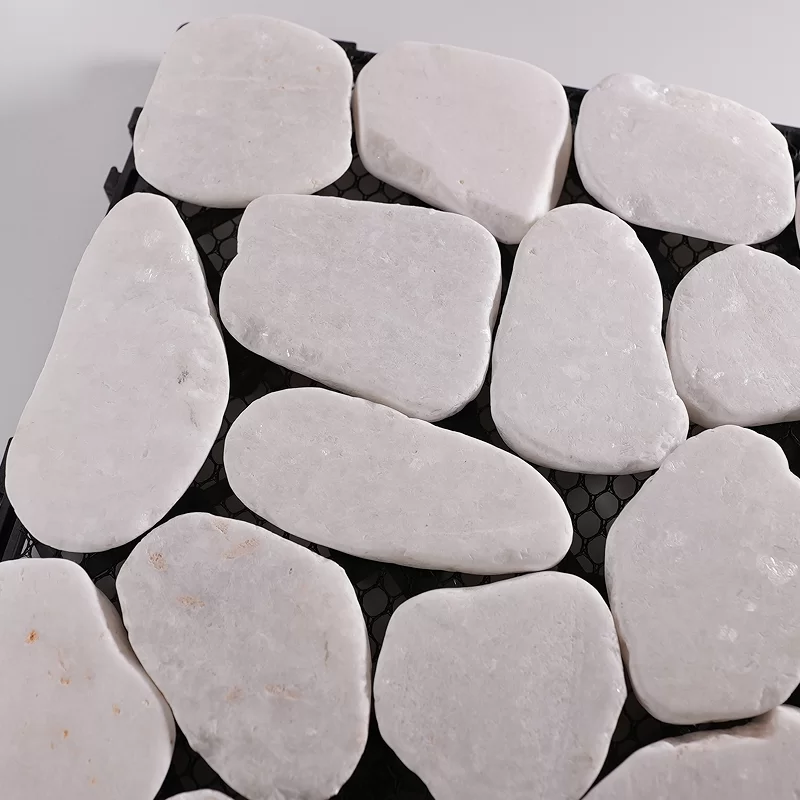
High-traffic public spaces and restaurant floors require dense mineral bodies such as stone, porcelain tiles, and heavy-gauge metals to withstand rolling loads and heavy foot traffic. Foot traffic durability depends on the specific compressive strength and abrasion resistance of the chosen mosaic material, with mineral density governing long-term survival under continuous service pressure.
Heavy rolling equipment and dense pedestrian streams demand non-porous surfaces that resist surface abrasion and fracturing across extended operational cycles.

Structural Integrity Under Rolling Loads
Restaurant floors and transport corridors experience constant mechanical stress from service carts and footwear. Vitreous materials and metallic inserts must be selected to prevent edge chipping or matrix collapse under concentrated point loads.
| material | application | Suitability for Humid Environments | Price Tier |
|---|---|---|---|
| stone | public places | Suitable | Dependent on volume |
| porcelain tiles | restaurants | Suitable | Dependent on volume |
| metals | public places | Restricted | Dependent on volume |
| ceramic | bath centers | Suitable | Dependent on volume |
Foot Traffic Durability Analysis
Surface degradation rates in commercial zones correlate directly with mineral hardness and aggregate packing density. Porous compositions wear down rapidly under abrasive dust and persistent foot traffic unless protected by compatible sealants.
Evaluating Substrate Compatibility in Mixed-Media Mosaics
Mixed-media assemblies combining metal, glass, crystal, shell, jade, stone, ceramic, and porcelain tiles require rigorous base preparation because dissimilar material components expand and contract at contrasting rates under variable thermal conditions. Purchasing managers evaluate these complex surfaces to prevent separation between decorative tiles and foundation mortar beds during building temperature cycles.
Substrate bonding parameters depend on the specific weight and surface absorption profile of each integrated component within the sheet matrix. High-density components like stone and porcelain demand modified mortar formulations, whereas lightweight glass and shell segments require compatible adhesives that prevent moisture entrapment behind non-porous faces.
Thermal Coefficient Behavior Across Mixed-Media Sheets
Thermal expansion mismatches present primary engineering challenges when exterior sunlight or indoor HVAC fluctuations trigger dimensional shifts across adjacent mosaic tiles. Metallic elements and crystal components react differently to ambient heat compared to ceramic bodies, creating internal shear stresses along grout joints.
Installation technicians mitigate these expansion differentials by selecting flexible polymer-modified bonding agents that accommodate minor movement without cracking individual tile edges. Procurement schedules must account for these adhesive specifications before dispatching installation materials to regional job sites.
Substrate Adhesion Parameters
| Material Combination | Suitability for Humid Environments | Price Tier | Required Documentation |
|---|---|---|---|
| Metal and Glass | Depends on exposure profile | High | Product specification sheets |
| Shell and Jade | Dry areas only | High | Material origin declarations |
| Stone and Ceramic | Suitable for wet installations | Moderate | Dimensional tolerance reports |
| Crystal and Porcelain Tiles | Sealed vertical zones | Variable | Batch testing summaries |
Substrate preparation protocols vary according to the architectural zone and the chosen material mixture. Heavy stone and metal combinations necessitate reinforced backing boards, while lighter porcelain and ceramic sheets adhere successfully to standard prepared plaster surfaces.
Purchasing agents coordinate with installation supervisors to verify that chosen mortar types match the absorption rates of both the mosaic face and the structural substrate. This cross-verification prevents premature tile detachment in demanding architectural applications.
Accounting for Site Cutting and Breakage Wastage Allowances
Calculating Wastage Ranging From 5 Percent to 10 Percent
Site installation practices demand calculated material reserves ranging from 5 percent to 10 percent to offset unavoidable breakage during manual fitting. Purchasing managers schedule these contingency margins directly into procurement volumes before shipments leave the warehouse. Precision cutting across dense mineral bodies requires physical buffers to prevent mid-project stock shortages.
Installation teams verify exact cutting requirements against site dimensions prior to final layout placement. Material losses vary directly with the complexity of the architectural geometry and the specific adhesive mortar employed.
| material | application | Suitability for Humid Environments | Price Tier |
|---|---|---|---|
| ceramic | bathrooms | High moisture resistance | Dependent on volume |
| shell | homes | Low moisture resistance | Dependent on grade |
| stone | public places | High structural density | Dependent on batch size |
| metals | restaurants | Corrosion resistant grade | Dependent on alloy thickness |
Project budgets account for these contingency percentages based on destination port shipping schedules and minimum order quantities. Procurement planners adjust the total sheet count to ensure uninterrupted workflow across complex architectural zones.
Adjusting Allowances Based on Geometry and Pattern Intricacy
Sheet geometry and pattern intricacy govern the exact wastage percentage required for successful installation across walls and floors. Intricate curves and diagonal layouts generate higher off-cut volumes than standard rectangular installations. Purchasing agents calculate these adjustments by analyzing blueprint layouts and sheet dimensions.
Contractors evaluate the physical properties of glass, crystal, and jade to determine appropriate cutting tools and speed parameters. Detailed pattern configurations demand specialized handling to preserve edge integrity during on-site trimming.

Procurement volumes integrate these geometric factors to align final delivery counts with actual installation site conditions. Compliance documentation availability depends on destination port requirements and product tier.
Managing Documentation and Compliance for Project Shipments
Qualitative Compliance Documentation Availability
Qualitative compliance documentation availability depends entirely on destination port regulatory frameworks and specific import tier classifications. Purchasing agents verify that destination customs authorities accept standard commercial dossiers rather than unverified third-party claims before arranging international shipments.
Import regulations govern whether destination ports require specialized material declarations or basic commercial invoices. Border clearance timelines shift according to the specific documentation package submitted alongside the freight bill of lading.
Directing Procurement Teams for Document Requests
Procurement teams should request applicable compliance files directly from the supplier based on destination port requirements. Commercial buyers verify file completeness prior to dispatch to prevent customs delays at foreign ports of entry.
Internal review processes for material procurement verification involve cross-referencing invoice line items with physical delivery manifests. Warehouse receiving departments check batch numbers and material finishes against initial purchase order specifications before releasing shipments to active job sites.
Purchasing managers coordinate technical audits internally by reviewing surface wear tolerances and installation guidelines supplied by the manufacturer. Documentation validation relies on verifying that all accompanying test summaries match the physical shipment characteristics exactly.

Frequently Asked Questions
Calcareous stone and shell materials lack the high vitreous density required for constant horizontal water exposure. Project specifiers restrict these variants to dry vertical spaces such as accent walls and lobby columns where standing water is absent. Installing them vertically protects mineral matrices from moisture erosion and rising dampness.
Mixed-media mosaics combine materials such as metal, glass, crystal, shell, jade, stone, ceramic, and porcelain tiles within a single sheet format. Thermal coefficient variations across disparate material structures require careful evaluation of substrate compatibility. Procurement planners assess environmental thermal gradients to prevent adhesive bond failure in complex assemblies.
Standard site cutting and breakage allowances range from 5% to 10% for mosaic installations. Project estimators adjust these percentages based on sheet geometry, pattern intricacy, and layout complexity. Procurement volumes scale directly with total surface area plus the calculated wastage margin to prevent job-site material shortages.
Compliance documentation availability depends heavily on destination port requirements and regional import regulations. Procurement teams review local standards to determine whether material test reports or origin declarations are mandatory for customs clearance. Verification timelines vary depending on whether the cargo route involves commercial or residential distribution channels.
Jade and crystal tiles suit localized interior spaces like kitchens when protected from continuous heavy moisture immersion. Procurement specifiers evaluate chemical exposure risks from cleaning agents before routing delicate mineral accents to vertical kitchen surfaces. Substrate sealing requirements depend on the specific binder and grout selected for the installation perimeter.
Conclusion
Procurement Verification Workflow for Commercial Mosaic Projects
Procurement managers execute systematic architectural reviews by cross-referencing site exposure zones against the approved material whitelist.
Logistical timelines and contract costs vary depending on destination port regulations and total order volume.
Internal Audit Protocols for Project Shipments
Internal review teams audit order quantities, surface classifications, and shipment schedules before final payment release.
Documentation requests remain dependent on regional customs clearance parameters and specific carrier requirements.